
Arka Shakti A Promising Rootstock Solution for Disease Management in Watermelon
Log in to save- Published
- 1 view
- 2 min read
Source: iihr.res.in
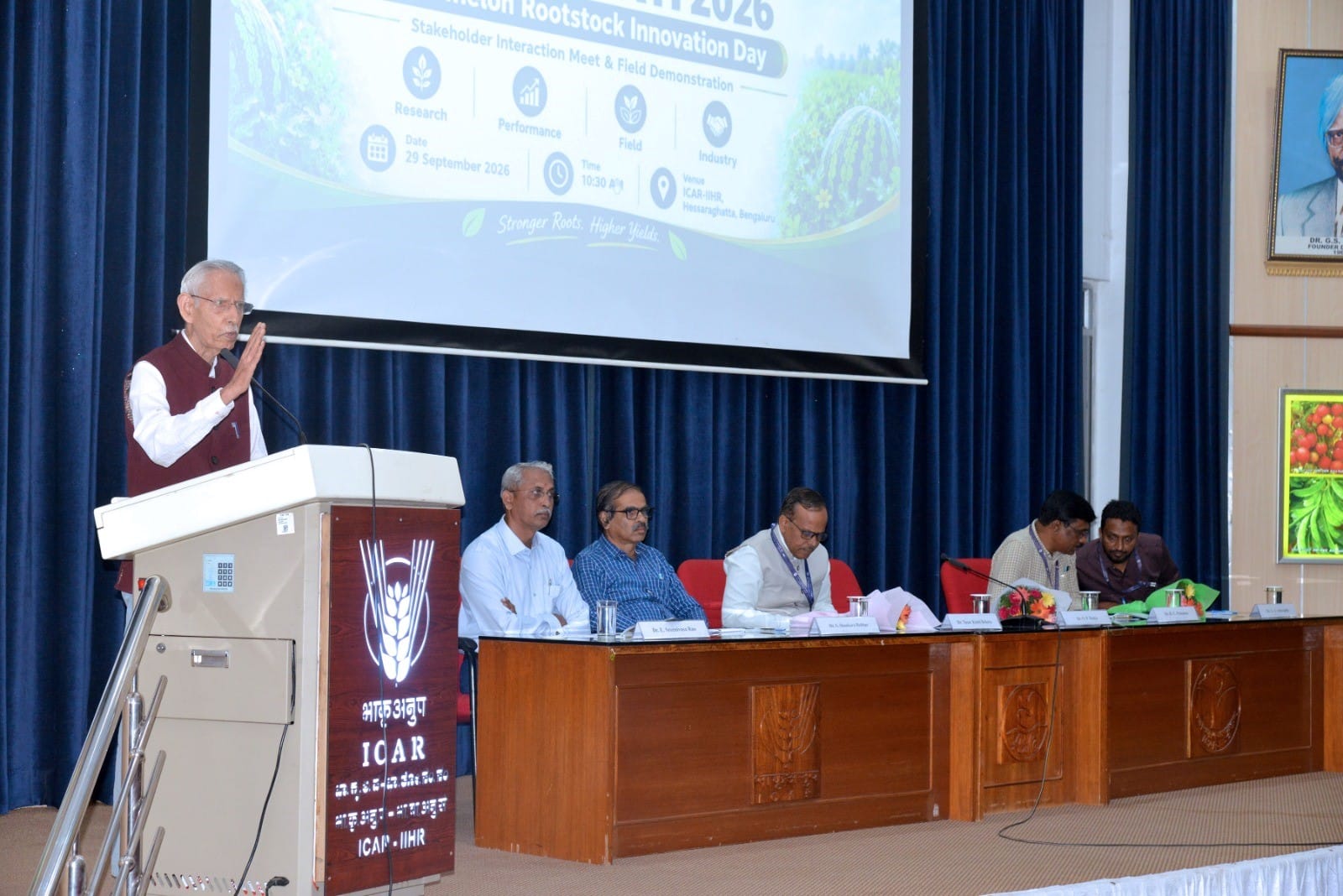
Watermelon cultivation in India faces a growing challenge from Gummy Stem Blight and Fusarium wilt, diseases that can cause severe crop losses and threaten the sustainability of cultivation in traditional growing regions. Rootstock grafting offers a promising approach to addressing these challenges, and ICAR–Indian Institute of Horticultural Research (ICAR-IIHR), Bengaluru, has developed Arka Shakti, a watermelon rootstock hybrid with tolerance to these diseases.
Why is rootstock grafting important?
Gummy Stem Blight, caused by the fungal pathogen Stagonosporopsis cucurbitacearum, can occur alongside Fusarium wilt, resulting in a disease complex that is difficult to manage. The pathogens can spread through seeds, soil and air. Although chemical measures can help manage seed-borne and aerial infections, soil-borne infections remain particularly difficult to control.
Rootstock grafting can help address this challenge by combining a disease-tolerant root system with the desirable fruiting characteristics of a cultivated watermelon variety. This approach offers an additional tool for integrated disease management.
Arka Shakti: An ICAR-IIHR innovation
Arka Shakti is an interspecific hybrid developed using Citrullus amarus and Citrullus lanatus accessions tolerant to Gummy Stem Blight and Fusarium wilt.
The technology is intended to support watermelon cultivation in disease-prone areas. Its practical value needs to be assessed alongside fruit yield, quality, grafting success, production costs and suitability under local growing conditions.
What does the technology offer?
Disease management: Offers a potential strategy for reducing the impact of major watermelon diseases.
Crop resilience: Provides an opportunity to improve production in fields affected by soil-borne pathogens.
Quality production: Enables the use of a suitable cultivated watermelon scion while benefiting from the rootstock's characteristics.
Technology collaboration: Creates opportunities for cooperation among researchers, seed companies, grafting nurseries and farmers.
From research to field application
ICAR-IIHR showcased Arka Shakti during a Watermelon Rootstock Innovation Day held on 29 September 2026 at Bengaluru. A field demonstration compared grafted watermelon with directly sown plants, with attention to yield, fruit quality and disease incidence.
The programme brought together representatives from 20 seed companies, 15 grafting nursery companies and several farmers. Discussions highlighted the need to strengthen rootstock–scion compatibility research, expand breeding for disease tolerance and maintain fruit quality when using rootstocks derived from wild relatives.
The way forward
Rootstock grafting is an established approach in vegetable production in several parts of the world, but wider adoption in India will require reliable grafted seedlings, appropriate nursery practices, field validation and clear economic benefits for farmers.
Arka Shakti represents an important research effort towards improving watermelon production under disease pressure. Its wider use will depend on continued evaluation across locations, suitable scion selection and integration with other recommended crop-management practices.
Disease-tolerant rootstocks such as Arka Shakti could become an important component of integrated disease management in watermelon, helping researchers and farmers explore more resilient production systems.


Comments
No comments yet. Be the first to share your thoughts.
Log in to leave a comment.