
Punjab’s Paddy Transformation A Success Story in Sustainable Mechanization
Log in to save- Published
- 126 views
- 3 min read
Source: icar.org.in
Punjab, a major rice-producing state, has long relied on migrant labour for manual paddy transplanting. However, soaring labour wages—now ranging from ₹4,000 to ₹5,000 per acre have made traditional transplanting financially unsustainable, particularly for small and marginal farmers. Compounding this challenge is the conventional puddling method, which significantly depletes groundwater. Alarmingly, over 80% of the state’s blocks are categorized as “over-exploited,” with groundwater extraction exceeding 157% of recharge levels.
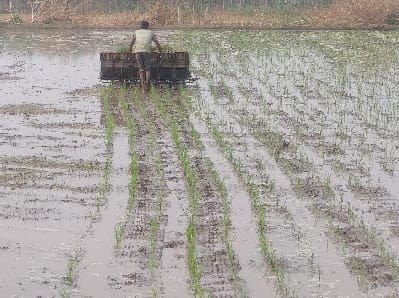
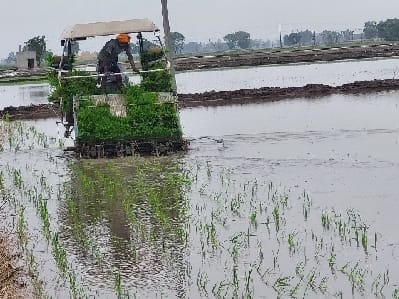
In response, mechanical paddy transplanting has emerged as a sustainable and scalable solution, addressing the intertwined challenges of labour scarcity, escalating input costs, and water stress. Adoption, though gradual, is steadily increasing from just 0.03 lakh hectares (0.1%) in 2015 to 0.37 lakh hectares (1.1%) by 2024. Farmers are progressively adopting a range of transplanters, including walk-behind, single-wheel, and four-wheel self-propelled models, which ensure uniform planting, optimal plant population, and improved crop performance.
A crucial component of this shift is the preparation of mat-type nurseries, which are essential for mechanical transplanting. Traditionally prepared manually where two workers can sow enough nursery for two hectares per day the process is labour-intensive and time-consuming.
To overcome this bottleneck, Punjab Agricultural University, Ludhiana developed a tractor-operated mat-type nursery seeder. This innovative, user-friendly implement compatible with 40 hp or higher tractors performs all essential nursery operations in a single pass and can prepare mat nurseries sufficient for 70–80 hectares in a single day. This breakthrough significantly reduces labour requirements while enhancing efficiency and consistency.
Table 1. Performance evaluation of manual vs mechanical transplanting in paddy
Particulars
Self-propelled walk behind paddy transplanter
Self-propelled single wheel paddy transplanter
Self-propelled four-wheel paddy transplanter
Farmer’s Practice (manual transplanting)
Row to row spacing (cm)
30 (4 & 6 rows)
30 (4 rows)
30 (6 rows)
-
Plant to plant spacing (cm)
14
14
14
-
Hills (No./m2) at transplanting
23.20a
22.18b
22.92a
16c
Missing hills (%)
2.56b
10.24a
3.74b
-
Mortality (%)
3.43b
10.75a
3.70b
-
Field capacity (ha/day)
0.8-1.2 (1.0b)
1.12-1.3 (1.2b)
2.5-3.0 (2.92a)
-
Plant stand (No./m2) 15 DAT
23
19
23
16
Panicles (No./m2)
319.3a
279.7b
319.9a
275.9c
Grain yield (q/ha)
75.93b
74.81c
76.82a
73.91d
Cost of production (Rs/ha)
57715
57470
56520
64423
Net returns (Rs/ha)
116924
114593
120166
105571
B:C ratio
3.03
2.99
3.13
2.64
During Kharif 2024, extensive field demonstrations and validation trials were conducted at 30 locations across six districts Hoshiarpur, Sangrur, Jalandhar, Kapurthala, Ludhiana, and Ferozepur. The results confirmed that mechanical transplanting methods outperformed manual approaches, offering higher efficiency, better crop establishment, and improved economic returns.
SWOT Analysis of Mechanical Paddy Transplantation
Strengths
• Enhanced work efficiency over manual method.
• Ensures uniform and adjustable plant spacing.
• Increased plants per hill, resulting in improved yield.
Weaknesses
• Necessitates laser levelling and precise field preparation.
• Unsuitable for light textured soils.
• Requires skilled operation and proper care for nurseries.
Opportunities
• High potential due to vast paddy acreage.
• Feasible for custom hiring supported by government subsidies.
• Labour shortages drive demand, leading to job creation in service and repair sectors.
Threats
• Limited training in nursery management and machine operation.
• High initial investment and limited availability of spare parts.
• Small-scale farmers may encounter challenges in adoption.
From a pilot initiative to a proven, climate-resilient cultivation method, mechanical paddy transplanting has become a cornerstone of Punjab’s agricultural transformation. It ensures timely sowing, uniform plant stands, and significant water savings critical in the face of severe groundwater depletion.
Backed by institutional innovation, hands-on training, and increasing farmer adoption, Punjab is setting a national example in sustainable paddy mechanization turning technological potential into long-term agricultural progress.
(Source: Punjab Agricultural University, Krishi Vigyan Kendra, Hoshiarpur and ICAR-Agricultural Technology Application Research Institute, Ludhiana, Punjab)
Comments
No comments yet. Be the first to share your thoughts.
Log in to leave a comment.