
Introduction:
There are about 700 different Eucalyptus species in the world and the majority of them are located in Australia. Nearly 170 species are believed to have been tested under Indian conditions and a handful is considered essential for industrial application. Eucalyptus camaldulensis and E. tereticornis are ideally suited for the plains.
Origin: It belongs to Australia
Distribution: It is distributed in the states of Tamil Nadu, Andhra Pradesh, Karnataka, and Hilly regions. E. camaldulensis and E. tereticornis are found in plains and E. globulus and E. grandis are found in Hills.
SpeciesCommon nameAltitudeRainfallEucalyptus tereticornisMysore gumUp to 500 MSL750-1000 mmE. camaldulensisRiver red gumUp to 500 MSL750-1000 mmE. grandisRed gum1400 m MSL1200-1500 mmE. globulusBlue gum2500 m MSL1200-1800 mmE. citriodoraLemon scented gum2500 m MSL1200-1800 mm
Climate: Eucalyptus camaldulensis and E. tereticornis perform well in areas of about 800-1000 mm rainfall. Its altitudinal range is limited to about 0-500 m above sea level.
Soil: It performs well in sandy loam to loam soils within a pH range of 6.0-7.5.
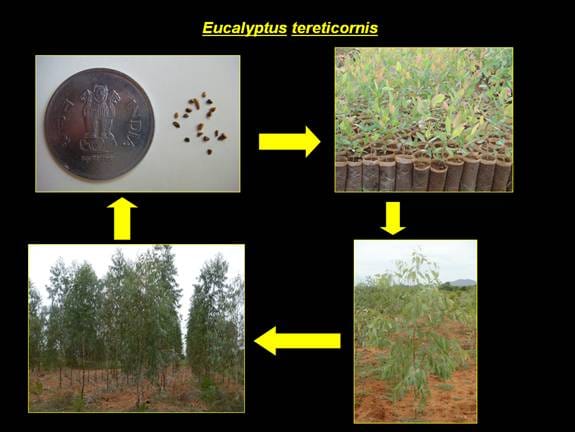
Nursery Technology: The seeds are very minute and pretreatment is not necessary. Seeds number about 3,00,000 – 3,50,000 in a kilogram and they possess a germinability of 40-45 per cent. The seeds retain their viability for long periods. The seeds are mixed with an equal amount of sand and spread over the raised beds of 2m length, width of 1 m and height of 15 cm and covered with a thin film of nursery soil or sand (up to 2 cm). The bed is covered or mulched with dry grass or paddy straw or coir waste, to prevent the washing of seeds and to protect the germinated seedlings. The nursery bed needs to be kept moist by watering twice daily. Insecticide has to be applied to prevent ant/termite attack and 2% copper fungicide must be applied. Germination starts on the 7th day onwards. Since seedlings are sensitive to extreme sunlight, the bed has to be protected by providing shade (temporary pandal) during the first fortnight. The seedlings are maintained in the mother bed up to thirty days, and they are gently lifted from the bed and transferred to polybags containing pot mixture and kept under shade for a week or two and maintained up to 6 months. The containers must be shifted once every month to prevent rooting. The seedlings are retained in the polypots for 6 months and after that planted in the main field.
Planting Techniques: Planting is done in pits of 30 cm³ during monsoon rains and formation of a saucer basin around each plant for water harvesting is made. Application of one basket of compost or FYM at the time of planting is required. Protection is needed in red soil areas to keep away termite attack. The spacing adopted for pulpwood: 2x2 m; Agroforestry: 4 x 1 m; Fuelwood: 1 x 1 m. Weeding is done during the first year of planting and also soil working every year during monsoon rains and summer rains.
Rotation and Harvest: Eucalyptus has a rotation age of 7 years for species grown in plains and 10 years for species grown in hills.
Yield: The estimated yield is 25-30 t/ha from plains and 60 t/ha from hills.
Uses: Pulpwood for paper and viscose, rayon industries and also a very good fuelwood.