
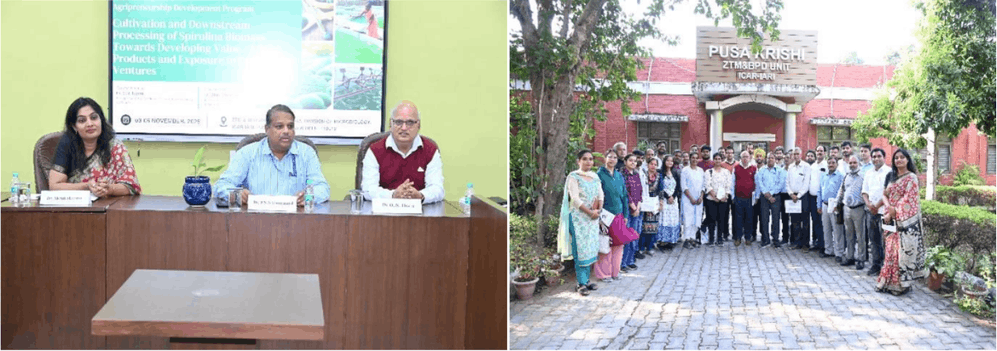
The ZTM & BPD Unit, in collaboration with the CCUBGA and the Division of Microbiology, ICARIARI, organized a 4-day hands-on training program on “Cultivation and Downstream Processing of
Spirulina Biomass Towards Developing Value-Added Products & Exposure to Commercial Ventures”
from 3rd to 6
th November 2025. The training aimed to provide participants with practical knowledge and
technical expertise on Spirulina cultivation, processing and commercialization opportunities.
The training was inaugurated on Monday, 3rd November 2025, in the presence of Dr. C. Viswanathan,
Joint Director (Research), ICAR–IARI, who graced the occasion as the Guest of Honour. Also, present
were Dr. O.P. Tiwari and Dr. G. Abraham, Principal Scientists from the Division of Microbiology, IARI,
along with Dr. Akriti Sharma, In-charge of the ZTM & BPD Unit. In his inaugural address, Dr.
Viswanathan emphasized the significance of Spirulina as a sustainable and nutrient-rich bioresource
with immense potential in the food, health and nutraceutical sectors.
Over the four days, participants were exposed to a wide range of scientific, technical and commercial
aspects of Spirulina production. The training focused on key processes such as drying, harvesting and
product development, along with the latest technological advancements for the mass production of
Spirulina platensis. Experts guided participants on the formulation of nutraceuticals and functional
foods derived from Spirulina biomass, emphasizing its immense potential in the health and food
industries.
Dedicated sessions were also conducted on the popularization and large-scale cultivation of Spirulina
in the northeastern region of India, highlighting the region’s favourable climatic conditions, resource
availability and potential to evolve as a major hub for Spirulina farming and rural entrepreneurship.
As part of the program, trainees visited the Division of Microbiology, where they engaged in interactive
sessions with the Head of Division, Dr Radha Prasanna and other scientists on various aspects of
biofertilizers. They also toured multiple facilities, including the biofertilizer production unit,
mycorrhiza production unit and PUSA decomposer unit, gaining insights into microbial technologies
that support sustainable agriculture. These interactions deepened participants’ understanding of
Spirulina cultivation systems, biomass processing and opportunities for innovation in developing valueadded products.
A major highlight of the program was the visit to a commercial Spirulina production site at Chhapraula,
G.B. Nagar (Noida), Uttar Pradesh. The visit offered the participants practical exposure to large-scale
Spirulina cultivation and downstream processing techniques. They observed different stages of
production, from culture maintenance and harvesting to drying and packaging. The visit also provided
insights into the marketing and business aspects of Spirulina-based products, thereby linking scientific
knowledge with entrepreneurial application.
The training concluded on 6 November 2025, with a valedictory session graced by Dr. P.S. Brahmanand,
Project Director, Water Technology Centre, ICAR-IARI, who attended as the Chief Guest. In his
address, Dr. Brahmanand congratulated the organizers and participants for the successful completion of
the training and encouraged them to actively apply the knowledge gained in their professional pursuits.
He emphasized the importance of such capacity-building programs in advancing sustainable
agricultural practices and promoting innovation-driven agribusinesses.
Participants expressed appreciation for the comprehensive design of the training, which combined
theoretical sessions, laboratory demonstrations and industrial exposure. They noted that the program
enhanced their understanding of Spirulina as a promising avenue for sustainable food production and
rural entrepreneurship.
https://www.iari.res.in/files/Latest-News/Spirulina_Cultivation_and_Development_07112025.pdf