
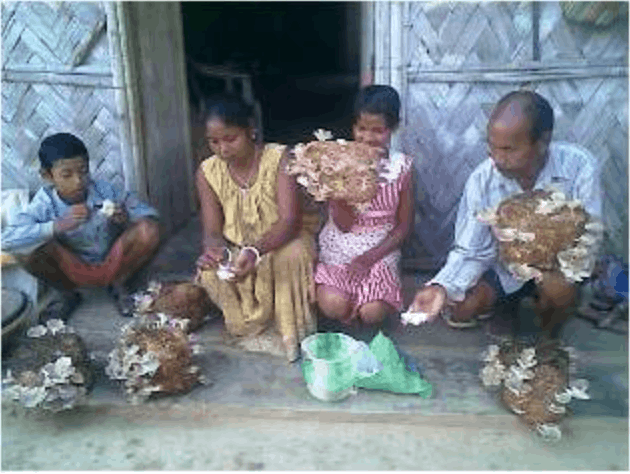
Two clusters, namely Balaram and Maracherra of Dhalai district in Tripura, were identified with less irrigation facility coupled with low cropping intensity. The local farmers were bound to have paddy as the solo crop twice a year with intermittent vegetable outputs that did not do well in raising extra income generation.
Therefore, mushroom cultivation was started off as an extra livelihood generation amongst the farmers by the ICAR in close collaboration with the regional center of ICAR for NEH region at Tripura, under the NAIP project “livelihood improvement”.
Project Initiation and Growth
Mushroom cultivation was first initiated through an in-situ training cum live demonstration in all six Self Help Groups (SHGs) of Dhalai Districts along with fifty-five beneficiaries in May 2008. The six SHGs involved were:
- Abachanga
- Khabaksha
- Sharda
- Pohor
- Bodol
- Loknath
Till December 2010, 216 farmers had started mushroom cultivation.
Economic Impact and Production Data
Farmers produced 2062 kg of fresh oyster mushrooms at an expenditure cost of Rs. 46,492; at Rs. 12 for a poly bag filling. The farmers sold fresh oyster mushrooms at Rs. 80/kg to the local markets and earned Rs. 165,045. The net profit resulted in Rs. 118,509. Besides, an increase in employment of 1185 mandays was registered.
Furthermore, farmers used 882 & 889 mushroom spawns (each 150g) and produced 560.30 & 559.00 kg of fresh oyster mushroom (Pleurotus sajor-caju) in Balaram and Maracherra villages during April 2009 to March 2010, respectively.
Farmer Testimonials and Market Demand
Most restaurant menus have button mushroom dishes, Chinese Bhel, Malai Mushroom Curry, Mushroom Biryani, and Mushroom Gravy as the famously served mushroom items.
‘I am very happy to listen that my mushrooms are being served across various reputed hotels in and around the state,’ says Bimal Debnath from Balaram village.
“By selling oyster mushroom (Pleurotus sajor-caju) at Rs 80/kg at local market was like a distant dream that appears coming true slowly but surely with the technical and timely help provided by the ICAR,” says Rebika Sangma, a woman farmer from Balaram village.
Expert Insights and Future Outlook
“Since the demand for mushrooms is surging both nationally & internationally, production technologies should be applied accurately with sufficient technical inputs. There are many farmers who are coming forward to adopt this as business,” says Principal Investigator of the Project Dr G.C. Munda, ICAR, Barapani.
Mushroom cultivation ensured enhancement of family income at the cost of less investment. Waste materials easily disposed of into food materials enriching with nutrition is an extra benefit at the farmers’ hand. Sustainability depends upon regular construction of new sheds in order to increase mushroom production amongst interested beneficiaries. However, continuous mushroom spawns supply poses a challenge that can be sufficiently managed through improved techniques of spawn (seeds) production.
(Source: NAIP Sub-Project of Mass Media Mobilization, DKMA with inputs from ICAR complex for NEH region)
Source: https://icar.org.in/en/node/4125
